Your ticket classifier’s model got deprecated
What problem are we solving?
Imagine a support product that sends every incoming ticket to a large language
model (LLM) before a person sees it. The model must return a small JSON object,
such as {"category": "billing"}. A strict parser rejects markdown fences and
extra prose, then routes valid results to billing, technical, account, or refund.
The system has run on gpt-3.5-turbo for months. Its prompt and examples were
tuned for that model. When the provider deprecates it, changing one line in
config/llm.yml to gpt-4o-mini looks like a dependency update. Python unit
tests still pass, and a few staging examples look reasonable.
The risk is behavioral. A new model may wrap JSON in markdown, causing the parser
to record null, or interpret an unstated refund rule differently. The model ID
changed while the prompt did not. That one-line edit can break the whole setup:
the eval command, the required JSON shape, the labels, and the quality bar.
Driftless calls that setup the workflow contract (driftless.yml).
This is model-induced drift, a change in workflow behavior caused by changing
the model. It can also expose prompt drift, where a prompt tuned for the old
model no longer produces the required behavior.
What Driftless does
An evaluation, or eval, is a repeatable test of model behavior. An
evaluation harness is the command and code that run examples, parse outputs,
and calculate scores. Driftless runs your harness twice: once with the current
model, called the baseline, and once with the proposed model, called the
candidate.
Driftless then:
compares baseline and candidate under the same harness and current files.migrates by asking a repair generator—the model or mechanism that
proposes prompt changes—to edit only files allowed bydriftless.yml.- Tests the best repair on a holdout, evaluation rows hidden from repair and
candidate selection, to reduce overfitting to known examples. - Uses
reportto turn saved evidence into a reviewable summary. - Uses
open-prto preview or create a pull request when gates pass, or
preserves blocked evidence in an issue when they do not.
Driftless orchestrates this loop. Your harness, parser, and scoring logic remain
the source of truth.
If you remember one rule, use this one: run the candidate under the same
harness before merging a model change.
Before you start
This post uses two different fixtures:
- The bundled four-row demo is deterministic and key-free. It teaches the
command flow, not provider quality or statistical confidence. - The separate
support-classifier-svc
testbed has 290 labeled tickets, LiteLLM, and simulator plus live-API paths.
The testbed's parser deliberately does not rescue markdown-fenced output. That
strictness makes an output-shape change visible as an evaluation failure instead
of hiding a production parsing bug.
Before any repair, audit the labels. A label audit checks whether duplicate or
near-duplicate examples have contradictory expected answers. Prompt repair
cannot fix an evaluation set that defines “correct” inconsistently. Follow
post 5 first.
Repair reproduction boundary
The historical passing pull request #4 is a 290-label testbed artifact. The
published CLI reproduces a passing four-row repair with --generator fixture.
Regenerating PR #4's exact patch still needs provider-backed --generator llm
(or the testbed's own simulator) and may differ.
EXAMPLE_SUCCESS_PR.md keeps that 290-label testbed
result—0.904 tuning and 0.901 holdout—separate from the bundled four-row
saved fixture, whose metrics are 1.000.
Walkthrough
1. Learn the flow with the bundled demo
The following commands install Driftless, copy its four-row classifier, validate
the workflow contract, and compare the configured baseline with gpt-4o-mini:
pip install driftless
driftless copy-example support-classifier --out-dir driftless-classifier-demo
cd driftless-classifier-demo
driftless validate -w support_classifier
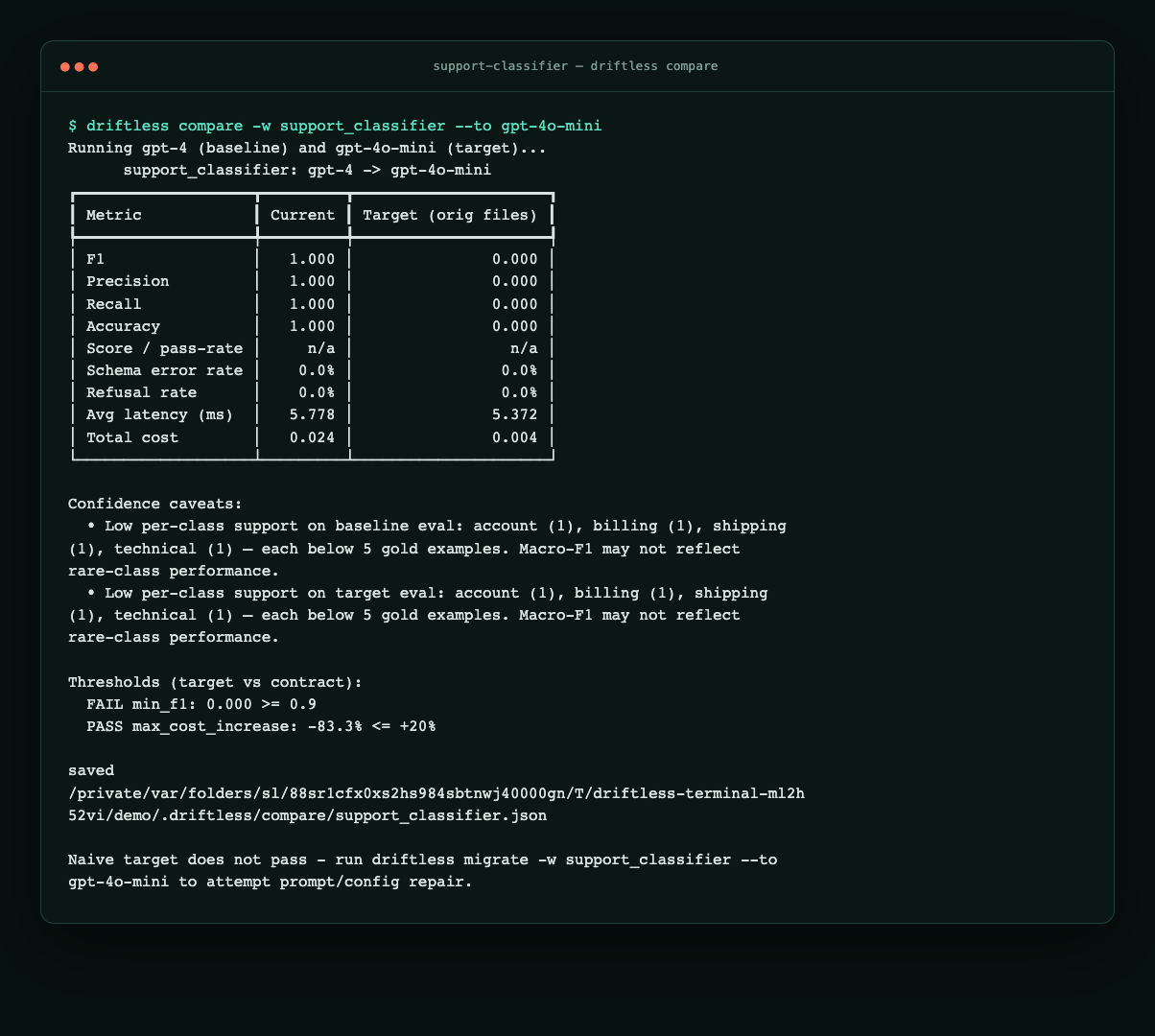
driftless compare -w support_classifier --to gpt-4o-mini
Expect macro-F1 to fall from 1.000 to 0.000 while cost falls from 0.024
to 0.004. Read a line like FAIL min_f1: 0.000 >= 0.9 as: the cheap model
scored 0.000, you required at least 0.9. Macro-F1 averages each
category's F1 score without weighting by category size; F1 balances precision
and recall. This result proves that compare and the quality gate work. It does
not estimate either provider model's quality.
Current CLI output may also include average-latency rows and a
Confidence caveats section. On a four-row fixture, those warnings emphasize
that the sample is too small for a reliable production migration decision; they
do not contradict the deterministic demo result.
--generator none makes no prompt edits, so migrate stays BLOCKED.
--generator fixture applies the known-good patch shipped with this example
and can pass, still without an API key. --generator llm is refused on this
simulator; use copy-example support-classifier-live for a harness that
calls OpenAI. On a customer workflow, --generator llm needs credentials
and is nondeterministic.
2. Reproduce the regression in the 290-row testbed
The next commands clone and install the external testbed, restore the hand-written
prompt used before repair, enable its deterministic simulator, and compare the
same two models:
git clone https://github.com/driftless-dev/support-classifier-svc
cd support-classifier-svc
pip install -r requirements.txt driftless

cp evals/fixtures/prompt-baseline-scenario3.md prompts/system.md

export SUPPORT_CLASSIFIER_SIMULATE=1   # deterministic simulator, no API key
driftless compare -w support_classifier --to gpt-4o-mini
The baseline prompt says to respond in JSON, but it does not say “raw JSON only”:
- billing: questions about invoices, charges, payments, or subscriptions
- refund: the customer wants their money returned
...
Respond in JSON with a single "category" field, for example: {"category": "billing"}
In a simulator run from July 2026, expect this saved CLI evidence:
Running gpt-3.5-turbo (baseline) and gpt-4o-mini (target)...

┏━━━━━━━━━━━━━━━━━━━┳━━━━━━━━━┳━━━━━━━━━━━━━━━━━━━━━┓
┃ Metric            ┃ Current ┃ Target (orig files) ┃
┡━━━━━━━━━━━━━━━━━━━╇━━━━━━━━━╇━━━━━━━━━━━━━━━━━━━━━┩
│ F1                │   0.903 │               0.000 │
│ Schema error rate │    0.0% │              100.0% │
│ Total cost        │   0.033 │               0.011 │
└───────────────────┴─────────┴─────────────────────┘

Thresholds (target vs contract):
  FAIL min_f1: 0.000 >= 0.9
  FAIL max_schema_error_rate: 1.000 <= 0.02

Naive target does not pass - run driftless migrate ...
Schema error rate is the fraction of outputs that fail the required JSON
shape. Read FAIL min_f1: 0.000 >= 0.9 as scored 0.000, needed 0.9, and
FAIL max_schema_error_rate: 1.000 <= 0.02 as every row failed the parser (you
allowed at most 2%). Here every simulated candidate output is fenced JSON,
so the strict parser rejects all of them and F1 falls to zero. The current model
passes; the unmodified candidate fails both release thresholds.
Do not treat these simulator numbers as a provider benchmark. They are an
adversarial production-contract test. The live comparison later shows the more
common problem: no schema explosion, but a quality drop after a prompt has become
coupled to its old model.
3. Describe the workflow once
The committed driftless.yml connects the harness, model override, evaluation
data, editable files, and release gates. This abbreviated configuration shows
the important relationships:
workflows:
  support_classifier:
    run:
      command: python evals/run_eval.py
      input_path: evals/tickets.inputs.jsonl
      output_path: evals/outputs.jsonl
    model:
      current: gpt-3.5-turbo
      target_candidates: [gpt-4o-mini]
      env_var: SUPPORT_CLASSIFIER_MODEL
      config_file: config/llm.yml
      config_path: support_classifier.model
    files:
      editable: [prompts/system.md, prompts/examples.yml]
    eval:
      labels_path: evals/tickets.labels.jsonl
      label_field: category
      cost_field: cost_usd          # per-record cost for plan/compare
    thresholds:
      min_f1: 0.90
      max_schema_error_rate: 0.02
    migration:
      holdout_required: true
      max_iterations: 6
Driftless runs python evals/run_eval.py with
SUPPORT_CLASSIFIER_MODEL set; it does not recreate the testbed's
post-processing. cost_field identifies the per-record cost value used by
plan and compare. max_iterations limits repair attempts, and
holdout_required makes unseen-row validation mandatory.
Before comparing or repairing, run validation. This checks the configuration and
performs one harness run:
driftless validate -w support_classifier
Expect either a valid contract and successful harness execution or a focused
configuration/runtime error. Fix those errors before interpreting model scores.
4. Use compare as the pre-flight check
compare answers one narrow question: does the candidate pass today's contract
with today's prompt? It does not edit files. It saves JSON at
.driftless/compare/support_classifier.json, which later report and
open-pr commands can use.
Interpret the outcome this way:
- If the candidate passes all thresholds, it may be shippable as-is; review the
evidence and useopen-pr. - If it fails and prompt changes could address the failures, use
migrate. - If repaired tuning results pass but holdout still fails, do not merge. Preserve
the evidence in an issue and investigate.
5. Migrate, then prepare review evidence
The first command path below keeps classifier calls on the simulator while using
an LLM repair generator. The second uses live provider calls end to end. Both
require repair-generator credentials. The final command creates a pull request:
# Simulator harness, but LLM repair still needs generator credentials:
export OPENAI_API_KEY=...
SUPPORT_CLASSIFIER_SIMULATE=1 driftless migrate -w support_classifier \
  --to gpt-4o-mini --generator llm

# Real end-to-end (what the testbed's "Migrate model" Action does):
export OPENAI_API_KEY=...
driftless migrate -w support_classifier --to gpt-4o-mini --generator llm
driftless open-pr -w support_classifier --create
Expect migrate to propose changes only to prompts/system.md and
prompts/examples.yml, evaluate attempts, and apply the holdout gate. Expect
open-pr --create to include the scorecard, file diffs, and attempt log only
when the result is eligible. If holdout F1 cannot reach min_f1: 0.90, a blocked
result is correct; Driftless opens an issue with evidence instead of presenting a
false-confidence pull request.
SUPPORT_CLASSIFIER_SIMULATE=1 replaces calls made by the classifier harness.
It does not supply the separate LLM repair generator. Use --generator none for
a fully key-free no-repair check, and expect it to remain blocked.
The testbed's
migration workflow
restores the baseline prompt fixture, runs audit-labels, compare,
migrate --strict-label-audit, then open-pr --create.
--strict-label-audit stops repair when label problems make the target unsafe.
How to interpret the results
Passing means more than “the model answered.” The candidate must satisfy the
same parser, labels, cost accounting, and release gate as production.
The simulator intentionally exaggerates fenced-JSON failures so CI can prove the
workflow without keys. With the same hand-written prompt on live
gpt-3.5-turbo and gpt-4o-mini, macro-F1 is about 0.92 for both. The larger
regression appears after optimization has coupled a prompt to the old model.
Label evidence clearly as simulator or live API. Simulation proves orchestration
and contract-failure handling; live runs test provider behavior.
Deeper methodology: separate prompt debt from migration gain
Prompt debt is quality left unrealized because existing instructions or
examples are weak. To avoid claiming prompt cleanup as a migration benefit, the
testbed evaluates three prompts under both models on all 290 labels:
| Prompt | gpt-3.5-turbo |
gpt-4o-mini |
|---|---|---|
| P0 — original hand prompt | 0.922 | 0.904 |
| P_src* — optimized on source | 0.993 | 0.921 |
| P_tgt* — optimized on target | 1.000 | 0.987 |
P0 is the original hand-written prompt. P_src* was optimized while the source
model stayed pinned. P_tgt* was optimized while the target stayed pinned.
Evaluating every prompt under both models separates prompt debt from
model-induced drift:
0.922 → 0.993on the source is mostly prompt debt.0.993 → 0.921after the swap is model-induced drift.0.921 → 0.987after target repair is the migration gain to report.
See Measuring migration gains honestly
for the full method.
What happens when it fails?
Failure is a safety result, not an incomplete run:
- Contract or harness errors mean the test setup must be fixed before scores are
meaningful. - Label-audit failures mean labels must be corrected before repair.
- Candidate threshold failures mean the model swap must not be merged as-is.
- Holdout failure means a repair worked on rows it saw but did not generalize
well enough to release. - Missing repair credentials prevent
--generator llm; they do not justify
bypassing the gate.
The lifecycle catalog marks gpt-3.5-turbo deprecated, with a retirement date
in the past as of 2026. Both support_classifier and quick_triage still use
it. To ask plan which workflows need action, run the following with the
testbed simulator:
SUPPORT_CLASSIFIER_SIMULATE=1 driftless plan
Expect the two workflows to be grouped under one
gpt-3.5-turbo → gpt-4o-mini deprecation move, each with a regressing naive
comparison and an ISSUE (critical) decision. The saved evidence elsewhere in
this repository was captured 277 days after retirement, so current CLI columns
are represented as follows:
┃ Workflow           ┃ Trigger     ┃ Migrate                       ┃ Retires ┃ Naive     ┃ Decision         ┃
│ support_classifier │ deprecation │ gpt-3.5-turbo -> gpt-4o-mini │ -277d   │ regresses │ ISSUE (critical) │
│ quick_triage       │ deprecation │ gpt-3.5-turbo -> gpt-4o-mini │ -277d   │ regresses │ ISSUE (critical) │

2 workflow(s) need action across 1 model move(s):
  gpt-3.5-turbo -> gpt-4o-mini (deprecation): support_classifier, quick_triage
Retires is the number of days until retirement, so a negative value means the
date has passed. Naive summarizes the unchanged-prompt comparison. plan
discovers and groups work; it does not replace compare or perform repair.
Post 3 explains the CI flow.
Next steps
- If labels move while the model stays fixed, continue to
post 2 andrefine. - To schedule lifecycle checks in GitHub Actions, read
post 3 oninit-ciandplan. - To run the testbed workflow, open
support-classifier-svc
and choose Actions → Migrate model.